
Teaching Kids to Stay Safe Online: Conversations, Digital Skills + Warning Signs Parents need to know
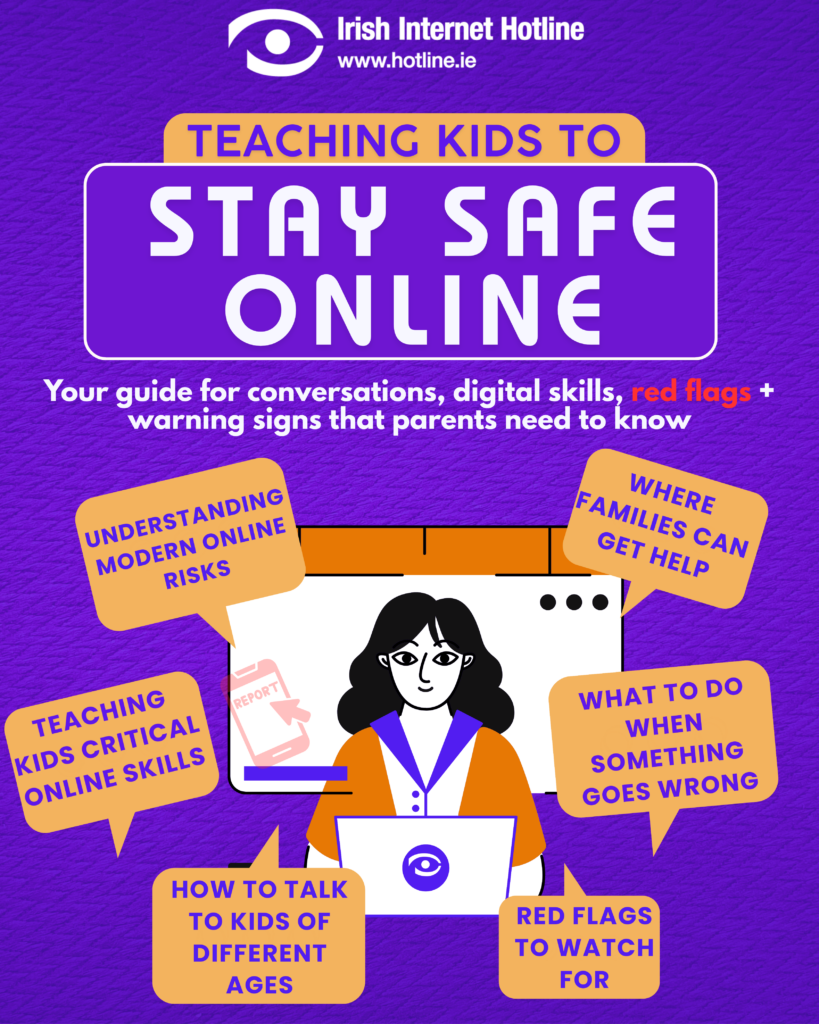
Last week, we here at Irish Internet Hotline published a blog post detailing some concrete steps parents and guardians can take to safeguard their children in the digital world. While the practical steps are important, arguably more important is that parents and children alike understand the risks of the internet’s ecosystem. Think of this not as fearmongering, but rather to arm guardians with the knowledge to insulate children from as many of these risks as possible. As always, knowledge is power.
To provide some context on the rather jarring reality, let’s take a look at a couple of figures. In 2024, Irish Internet Hotline received 53,411 reports of suspected illegal material, of which 85% of the related illegal material was child sexual abuse material (CSAM). A trend we noticed was that there was a sharp rise in self-generated CSAM, meaning images or videos children have made themselves. The term “self-generated” does not seek to apportion blame or suggest consent, or even awareness, but refers only to the apparent original of the material. Often the production of this imagery reflects grooming, coercion or pressure from someone online. This pattern is not unique to Ireland. In the UK, the NSPCC and the Metropolitan Police recorded over 7,200 cases of Sexual Communication with a Child Offences last year, almost double since the offence came into force in 2017. No matter how you slice it, the reality is clear: children are being targeted, pressured and exploited in online spaces, often in ways that are hidden from parents and carers until harm has already occurred.
This post provides practical guidance for parents and carers on talking to children about online safety, teaching essential digital skills, recognising warning signs of harm, and knowing where to seek support and report concerns in Ireland. Much of the advice here will become useful at different stages of your child’s development so feel free to bookmark it for later. With that said, let’s get started.
Generally speaking, the most common risks for young people on the internet can be broken down as follows. Often children can be vulnerable to more than one of the risks at a time, as many of them intersect.
Grooming and Exploitation:
Grooming is when a person builds a relationship with children or their families with the aim of child sexual abuse. Child exploitation is when someone uses a child for financial gain, sexual gratification, labour or personal advantage.
Criminals or predators use gaming or social media platforms to groom children for sexual exploitation, including sextortion and human tracking, adopting rapid or manipulative tactics. Grooming usually happens very quickly and deceptively.
Methods of grooming children for exploitation may include making your child feel special by flattery, presents, requests to keep the relationship secret, and exerting pressure to share images. This escalates into sextortion or other forms of sexual exploitation.
Another form of grooming is used to draw children and teenagers into criminal activity. A Dublin youth project called The Diamond Project told an Oireachtas committee recently that children as young as 12 are being groomed into drug networks, and they fear that children as young as communion-aged could be targeted by criminal gangs in this way. This form of grooming has potentially dire consequences for a young person, including involvement in gangs, drug distribution, or other forms of exploitation, by normalising risky behaviour or offering money, clothes and shoes, status, or a sense of belonging. More on this later on.
Harmful Content:
One of the main fears parents and guardians may have about their children’s internet use is potential exposure to harmful or illegal content. Depending on the age of the child, this may include: pornographic material, violent images (including towards both people and animals), live-streamed attacks and deepfakes, gore, or sites that encourage self-harm, hate speech, terrorism, disordered eating, suicide or other dangerous behaviours. To add to this concern, many platform’s algorithms display so-called “algorithmic radicalisation”; pushing users to more extreme content over time and into “echo chambers”, encouraging radicalisation, especially amongst young boys.
Cyberbullying & Harassment:
Cyberbullying remains a persistent issue for kids. For many of us, we know bullying is unfortunately nothing new or modern. What is relatively new though, is the reality that a child may have no respite from their bullies when they get home. Due to the reliance on social media and our phones, this form of bullying can be inescapable, constant, and have a wider or more permanent audience. Additionally, the ability to act with more anonymity has the tendency to reduce the bully’s empathy, and indeed embolden someone who would not be brave enough to bully a child in the physical world. Teachers and others who work closely with children have reported seeing rising anxiety and lack of focus in children who are cyberbullied.
Misinformation/Disinformation:
Misinformation and disinformation can pose serious risks to children, causing fear, promoting harmful ideologies, and eroding their trust in those around them. A child’s developing cognitive skills make them particularly susceptible, especially when trusted sources or peers promote false information.
All of this affects their well-being and should be countered by teaching media literacy as early as possible. A way to encourage this is promote critical thinking online by for example, source checking, bias examination and fact-checking.
Mental Health Impacts:
Excessive social media usage in children and teenagers has been repeatedly linked to an increased risk of anxiety and depression, poor sleep, negative body image and low self-esteem. Spending hours online every day can expose children to unrealistic comparisons, online pressure, and cyber bullying, all of which can affect their mood and confidence. Late-night device usage can disrupt healthy sleep patterns, further damaging mental wellbeing and concentration at school.
Data Privacy & Digital Footprint:
Children often don’t realise that everything they share can leave a permanent digital footprint. Photos, videos, comments and location tags can be copied or shared beyond their control. Younger children (especially those under the age of 12) lack the cognitive ability to grasp abstract, long-term consequences like future job prospects or reputational damage from current posts. They get caught up in the immediate social rewards and fun of sharing, forgetting content isn’t truly deleted.
Additionally, many children have a digital footprint from infancy, usually created by their parents, and long before they have agency. This makes it even more important to teach responsible sharing, privacy awareness and the implications of online behaviour from an early age.
Emerging & Growing Concerns
As tech continues to evolve, risks are constantly emerging for children and young people online. An awareness of these trends can help parents and carers guide their children safely.
Gaming platforms:
Popular online games (currently the most popular is Roblox) can provide social spaces for children to interact and play. While these platforms are a creative outlet for most children, they are increasingly and consistently targeted by predators, making them challenging to moderate effectively. Parents should be aware of the potential for inappropriate content, and friend requests or in-game features. It is not recommended to allow your child to give their username on another platform to someone they have met on Roblox as this has been identified as a frequent method to attempt to groom or exploit children.
Live streaming:
Real-time or live streaming is exactly what it sounds like. It’s a person or people streaming live from their home or out in public using webcams or inbuilt cameras on their phone. Because live content is immediate, moderation is very difficult and recordings can spread widely. Real-time streaming can as a result expose children to harmful and violent events as they happen. A prime example of this was the live streaming of two Islamophobic terrorist attacks in Christchurch, New Zealand in 2019, during which the murder of dozens of people was streamed to thousands of unsuspecting witnesses on Facebook, which inspired multiple copycat attacks.
Deepfakes + AI-Generated Content
Advances in AI have made it scarily easy to create realistic deepfake images, videos and audio. A deepfake is a type of digital that has been manipulated using artificial intelligence (AI) to make it look or sound like someone is saying or doing something they never actually did. Deepfakes can be very convincing, making it hard to tell that the content is fake. They can be used for entertainment, satire, or education, but also for harmful purposes like bullying, harassment, misinformation, or fraud. Children can be targeted through fake videos or images, or unknowingly share content that has been manipulated.
A Message for Parents and Carers
When you read a list like that, these risks can feel overwhelming and frightening. However, awareness is a powerful first step. You don’t need to know every app, trend, or technology. Here’s what matters most:
- Keep conversations open and ongoing.
- Listen without judgement
- Help children build skills, not fear
As an adult, and knowing the dangers of the real world, thinking or finding out your child has done something risky on the internet can be terrifying and frustrating. Nonetheless, it’s crucial that children know they can come to you and that you will help them. Knowing they have someone in their corner leaves them far better equipped to navigate the online world safely. If something doesn’t feel right, trust your instincts and seek support. Reporting concerns early can protect your child and others.
Helping children stay safe online is not just about giving them rules. It is about helping them develop the skills to make good decisions when adults are not around. These skills take time to grow and need to be reinforced as children get older.
Key Digital Skills to Build
Critical thinking
Encourage children to pause and ask questions about what they see online. They can think about whether something is real, who is sharing it, and why. They can also ask themselves if it feels right. This is becoming more important as AI-generated images, deepfakes, and misinformation become more common. For example, if a post seems shocking or too good to be true, children can learn to check multiple sources before believing or sharing it.
Privacy and boundaries
Children should understand what personal information is. This includes their name, school, photos, and location. Teach them why it should not be shared online with strangers or even friends they do not fully trust. Make sure they know they never have to send photos, reply to messages, or give explanations if they feel uncomfortable. They should feel confident in saying no.
Recognising pressure and manipulation
Explain that online pressure can take many forms. Someone might ask a child to keep secrets, try to make them act quickly by saying “do this now,” or use guilt and flattery to influence them. Children should understand that adults they trust do not ask them to hide things from their parents or carers. Encourage them to talk to someone they trust if anything feels wrong.
Responsible sharing and behaviour
Teach children to treat others online with respect. They should pause before posting or forwarding content and remember that screenshots or sharing mean that once something is online, it cannot always be taken back. Help them understand the impact of their words and actions on others.
Knowing when and how to get help
Children should know it is okay to stop a conversation if it makes them feel uncomfortable. They should also know how to block or report users on apps, social media, or games. Show them how to find the reporting tools on the platforms they use and explain that reporting is not tattling. It is a safe way to protect themselves and others. Reassure them that asking for help is a sign of strength, and that there are trusted adults and organisations ready to support them if something happens online.
A Message for Parents and Carers
Digital skills grow through practice and conversation, not fear. Small, regular chats, especially after something happens online, help children build confidence and resilience.
As a general rule, people do not enjoy having a serious “big talk” about anything. Children are no exception to this. Talking to children about their online safety isn’t a one-off conversation, but works best as many small, age-appropriate conversations that can evolve as your child grows. That said, a useful rule of thumb goes:
- Younger children need rules.
They are still developing self-control and understanding of risk, so simple and consistent rules help keep them safe. Examples include: only using devices in the living room, never sharing passwords, and asking permission before downloading or installing apps. Short, repeated reminders are more effective than long lectures.
- Tweens need explanations.
Children around 8 to 11 are more curious and independent. They start to ask “why” and want to understand how things work. This is a good time to explain why rules exist and what can happen if they are not followed. For example, you might explain why it is risky to talk to strangers online or why some videos are not suitable for their age. Encourage them to think critically and see mistakes as learning opportunities rather than failures.
- Teenagers need your trust and guidance.
Teenagers value privacy and independence. At this stage, your goal is to build trust and open communication rather than impose strict rules. Talk about real-life scenarios, encourage them to make decisions for themselves, and discuss the potential consequences of their online actions. Focus on teaching them to recognise risk, respect others, understand consent, and know where to get help if something goes wrong. Supportive guidance helps them develop responsible digital habits that will last into adulthood.
Ages 4–7
Setting up the conversation
Young children think in simple rules and need clear boundaries. Online safety works best when conversations are short, calm, and repeated often.
How to talk to them
Use everyday examples from their world, like games, cartoons, or school. Focus on practical things they can do to stay safe, and avoid scary stories. You can talk while doing something together, such as drawing, playing, or watching TV, so the conversation feels natural.
Conversation starters
- Who do you talk to when you play games online?
- What should you do if something pops up that feels weird or scary?
- Who are the grown-ups you can always tell?
Key messages
- Passwords are private. Only parents should know them.
- Be kind online. What you say matters just like in real life.
- Online strangers are not friends. Always ask before chatting or adding someone.
- Always tell a trusted adult. You will never get in trouble for speaking up.
Focus: At this age, children need clear rules to help them stay safe. They also need to understand that trusted adults will never ask them to keep secrets from their parents. Teaching kindness and encouraging them to speak up are just as important as rules.
Ages 8–11
Setting up the conversation
Children at this age are curious and becoming more independent. It is a good time to explain why rules exist and help them start taking responsibility for their choices online.
How to talk to them
Ask questions and invite them to think, rather than lecturing. Use real but age-appropriate examples. Emphasize that mistakes are learning opportunities.
Conversation starters
- What would you do if someone asked you to keep an online secret?
- Have you ever seen something online that made you uncomfortable?
- Why do you think some videos or games are not meant for kids?
Key messages
- Report anything inappropriate, including bullying or messages from strangers.
- Some content is not suitable for your age. Parental controls can help, and it is okay to ask why.
- Keep devices in shared spaces when possible. It helps you stay safe and form good habits.
- Think before posting. Once something is online it can be shared or copied by others.
Focus: At this age, children need explanations to understand why rules exist. They also need to know that trusted adults will never ask them to hide things from their parents. Encourage awareness, early critical thinking, and speaking up when something feels wrong.
Ages 12–14
Setting up the conversation
Early teens value privacy and independence. Conversations should be honest, calm, and free from judgement.
How to talk to them
Choose quiet moments to talk, and listen first. Avoid reacting with punishment. Acknowledge peer pressure and emotional challenges they may be facing.
Conversation starters
- What kind of pressure do teens feel online?
- What would you do if someone asked for a photo?
- If something went wrong online, who could you talk to?
Key messages
- Sharing intimate images of minors is illegal, even if both people are under 18.
- Groomers often ask children to keep secrets. Reassure them they will not get in trouble for speaking up.
- Cyberbullying is serious. It is okay to report it, and repeated harassment online is against the law.
Focus: At this age, children need to understand consent, the law, and the emotional impact of online behaviour. They also need to know that trusted adults will not ask them to keep secrets from their parents. Encourage open conversations and remind them it is always safe to speak up.
Ages 15–18
Setting up the conversation
Older teens are close to adulthood. The focus shifts from rules to understanding real-world consequences and making responsible choices online.
How to talk to them
Treat them as young adults. Talk about realistic scenarios rather than hypotheticals. Encourage independent thinking and discussion, rather than trying to control them.
Conversation starters
- How do you decide what is okay to post online?
- How might someone who does not know you see it?
- What would you do if an image or message was shared without your consent?
Key messages
- Your digital footprint matters. What you post can affect college, jobs, and relationships.
- Consent is non-negotiable. Sharing images or information about others without permission can be a crime.
- New risks are emerging online, including deepfakes, impersonation, scams, and manipulation.
- Know your supports. Reporting harmful content to platforms, schools, Gardaí, or the Irish Internet Hotline is the right step.
- Under Coco’s Law, serious online harm can have criminal consequences. “It was a joke” is not a defence.
Focus: Older teens need guidance to understand the long-term consequences of their online choices. They should know the law, the importance of consent, and how to protect themselves and others. Remind them that trusted adults will not ask them to keep secrets from their parents, and encourage them to reach out for help when something feels wrong.
Message to parents and carers
- You don’t need to have all the answers. What matters most is keeping conversations open, responding calmly, and reassuring children that help is always available. When something feels wrong online, reporting early can make a big difference.
- For concerns about illegal or harmful online content, families can contact: Irish Internet Hotline – hotline.ie
What is grooming?
Grooming is when someone slowly builds a relationship with a child, or sometimes with their family, in order to abuse them. Grooming is used to set up sexual abuse. Even after abuse has occurred, the person may keep grooming the child to make it easier to continue the abuse or to prevent the child from telling anyone. It often doesn’t look threatening at first. It can feel friendly, supportive, or even caring, which is why it can be so hard to spot.
Many children don’t realise they’re being groomed. They may think they’re in a relationship they want to protect, feel scared of getting someone into trouble, or blame themselves. Because of this, it’s rare for a child to come forward on their own.
Signs that might raise concern:
No single sign means a child is being groomed. Every child is different, and what matters is a change from what’s normal for your child, or several signs happening together.
- They become more secretive
Most children value privacy, especially teenagers. However, if your child suddenly becomes much more guarded about their phone, who they’re talking to, or what they’re doing online, it may be worth paying attention.
For example, they may quickly lock their screen or change apps when you enter the room or say “it’s nothing” more often than usual. - They’re spending noticeably more time online
Children already spend a lot of time online, so this can be tricky. However, if you notice them staying up late, being online at unusual times, or becoming upset when asked to log off, it could be a sign they’re communicating with someone who feels important to them. - Their mood or behaviour changes
All young people have ups and downs. What to look out for are changes that feel different or more intense; becoming withdrawn, unusually anxious, upset, or emotionally volatile. Some children may seem distracted or distant, others more irritable than usual. - They receive gifts or money you didn’t give them
Groomers often use gifts to build trust or create a sense of obligation. This might be a new phone, game credits, clothes, or cash they can’t (or won’t) explain. - They use sexual language or act in sexualised ways
You might hear your child using sexual words or references that don’t seem age-appropriate, or notice changes in how they talk about relationships or their body. - They start taking more risks
Some children who are being groomed may begin drinking alcohol, taking drugs, or engaging in other risky behaviours. These changes are often hidden, but can be a sign that something else is going on. - They spend more time away from home
This might look like going out more often, staying out late, or going missing for short periods. In some cases, a child may be meeting or planning to meet the person who is grooming them. - They have a close relationship with someone much older
This could be online or offline. If your child talks about someone significantly older who seems to have a lot of influence over them, it’s worth paying attention.
If something doesn’t sit right with you, trust that instinct.
You don’t need to have all the answers. What matters most is how you respond.
- Stay calm and listen
If your child tells you something worrying:
- Thank them for telling you. It often takes a lot of courage.
- Reassure them they are not in trouble and not to blame.
- Try to listen without interrupting or reacting straight away.
How you respond in that moment can make it much easier for them to keep talking.
- Keep evidence safe
If something has happened online:
- Take screenshots of messages, images, usernames, profiles, and web links.
- Save dates, times, and the name of the app or platform.
- Don’t delete accounts or messages as the Gardaí may need them as evidence.
- Don’t forward or share harmful content.
- Report and get help
You don’t have to deal with this alone.
- Illegal or harmful content involving children, including child sexual abuse material: Report it to us at the Irish Internet Hotline via hotline.ie.
Reports are secure and can be made anonymously. - Grooming, serious harm, threats, or image abuse: Contact An Garda Síochána at your local Garda station, or call emergency services if a child is in immediate danger. Garda Child Sexual Abuse Helpline: 1800 555 222
- On social media, games, or apps: Use the platform’s reporting and blocking tools.
- Keep supporting your child
The impact of online harm doesn’t always show up straight away.
- Check in regularly, even weeks later.
- Keep conversations open and judgement-free.
- If your child seems anxious, withdrawn, or distressed, consider seeking extra support.
Irish Internet Hotline
We are Ireland’s national reporting service for illegal and harmful online content, specialising in child sexual abuse material and serious online harms. We work with online platforms, hosting providers and law enforcement to have illegal content removed.
An Garda Síochána
If a child is in immediate danger, or if a serious crime has occurred, contact An Garda Síochána. Gardaí can investigate criminal offences and advise on next steps.
Emergency: 999 or 112
Non-emergency: Contact your local Garda station
Webwise
Ireland’s national internet safety awareness initiative, providing trusted advice and practical resources for parents, carers, teachers and schools, particularly around platforms, privacy settings and age-appropriate use.
CyberSafeKids
An Irish charity supporting children and families to use the internet safely through parent resources, school programmes and practical guidance that builds digital skills and confidence.
ISPCC / Childline
Provides emotional support for children and young people affected by online harm. Parents can also contact the ISPCC for advice and guidance.
Childline: Freephone 1800 66 66 66 | Text 50808
Schools
Principals, year heads and guidance counsellors can support children experiencing online issues, including bullying, wellbeing concerns and referrals to additional supports.
A Reassuring Reminder for Parents
Online harm can feel overwhelming, but help is available. Reporting concerns early and reaching out to trusted Irish organisations can protect your child and prevent further harm. If you’re unsure where to start, report to us at hotline.ie.